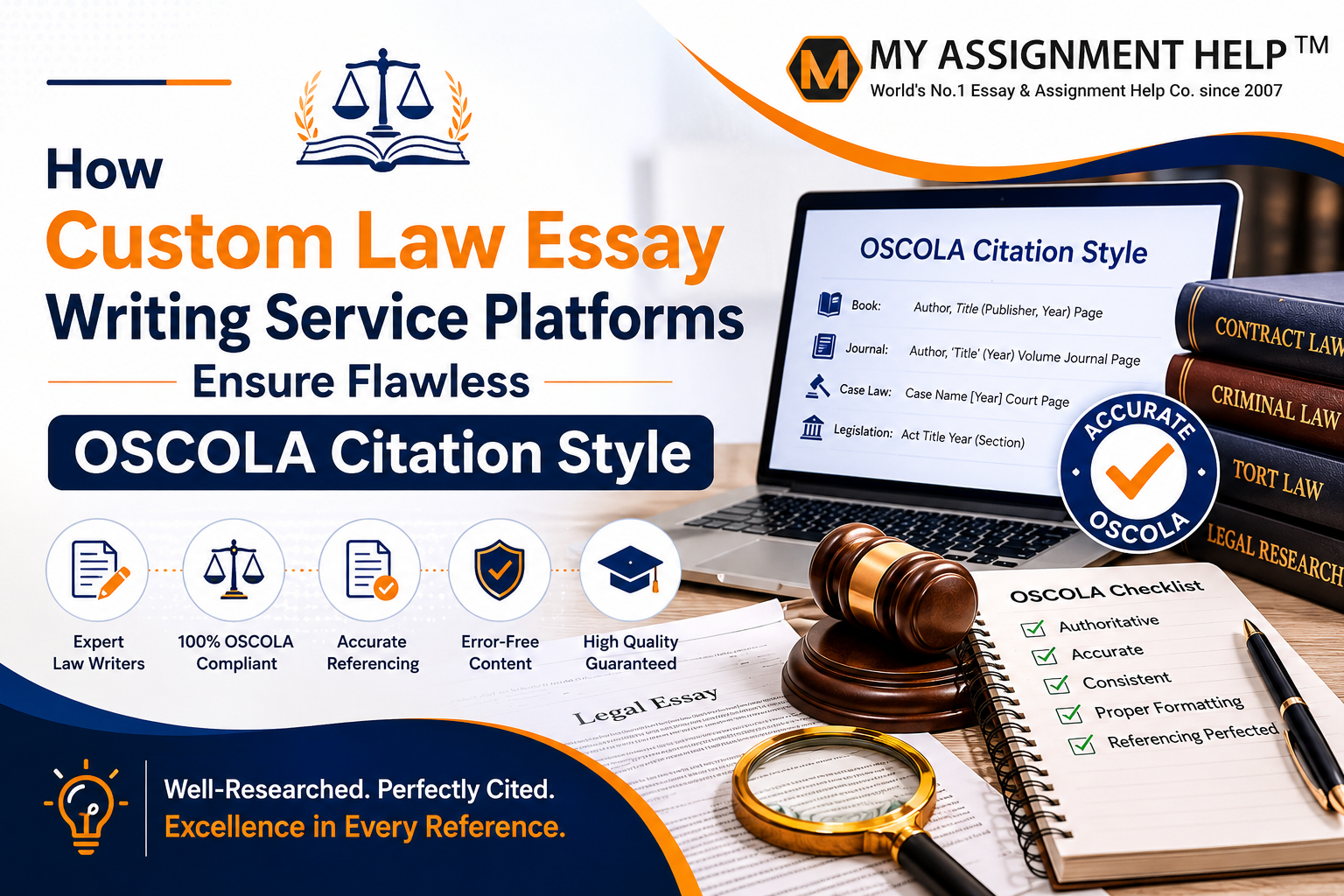
Mastering the Oxford Standard for Citation of Legal Authorities (OSCOLA) is one of the toughest challenges for law students. Unlike standard academic formats like APA or Harvard, OSCOLA relies entirely on a complex system of footnotes and minimal punctuation. A single misplaced comma or an incorrect bracket can lead to lower grades.
Because the margins for error are non-existent, many students choose to seek expert help. Utilizing a premium law essay writing service ensures that complex assignments are handled by professionals who understand how to weave arguments and citations together seamlessly. Academic platforms deploy specialized strategies, rigorous multi-stage quality checks, and seasoned legal scholars to ensure every footnote and bibliography entry aligns perfectly with the strict demands of the Oxford manual.
Understanding the Hidden Complexities of OSCOLA
To appreciate how custom platforms achieve perfection, it helps to understand why OSCOLA trips up so many writers. The primary rule of OSCOLA is the complete removal of unnecessary punctuation. There are no full stops after initials or abbreviations. For example, a standard case citation looks like Corr v IBC Vehicles Ltd [2008] UKHL 13, [2008] 1 AC 884.
The system also handles square and round brackets based on specific technical rules:
- Square Brackets : Used when the year is essential to identify the specific volume of the law report.
- Round Brackets : Used when the report has consecutive volume numbers, making the year of the judgment supplementary.
Managing these rules alongside specific pinpointing guidelines for different courts requires specialized expertise. When students face tight deadlines, they often tell academic experts to “write assignment for me” to ensure these technical rules are followed perfectly. Professional legal writing services manage these details by turning formatting into an exact science.
The Operational Blueprint: How Platforms Ensure Flawless Citations
1. Recruiting Elite Legal Experts
Professional platforms do not rely on general academic writers. They hire legal scholars, solicitors, and barristers who have used OSCOLA throughout their professional lives. These writers understand the difference between primary sources, like cases and statutes, and secondary sources, like journal articles and textbooks. Because they understand the source material deeply, they naturally format the citations correctly during the drafting process.
2. Multi-Tiered Editorial Quality Control
Achieving zero errors requires a dedicated editorial process. Once a writer finishes an essay, the draft passes through a strict quality assurance pipeline:
- Primary Edit: A senior legal editor checks the logical flow, legal arguments, and the presence of all required case laws.
- Citation Verification: A dedicated formatting specialist verifies every footnote against the official OSCOLA manual. They confirm that neutral citations are used correctly and that subsequent citations use proper cross-referencing techniques, like ibid or shortened forms.
- Software Validation: Advanced grammar and style checkers assist the editors by scanning the document for structural consistency.
3. Clear Distinction Between Primary and Secondary Sources
An essay can easily lose points if it mixes up the formatting rules for different types of sources. Custom platforms use distinct workflows to handle different reference categories:
| Source Type | OSCOLA Formatting Rule | Practical Example |
| UK Statutes | Act Title and Year, without punctuation. Sections use lower-case letters. | Human Rights Act 1998, s 15(1)(a). |
| Journal Articles | Author, ‘Title’ [Year] Journal Name Page. Single quotes for title. | Paul Craig, ‘Theory and Values in Public Law’ [2005] PL 440. |
| Books | Author, Title (Edition, Publisher Year). Title is italicized. | Jonathan Herring, Criminal Law (8th edn, OUP 2018). |
4. Flawless Subsequent Referencing and Cross-Linking
In long legal essays, citing the same source multiple times can become confusing. OSCOLA handles this by using shortened forms and cross-references. If a source is cited in the immediate next footnote, professional editors use ibid. If the source appears later in the document, they use a shortened version of the author’s name or case name along with a back-reference to the original footnote number, such as Herring (n 2) 415. Custom platforms track these links carefully so that any changes to the text do not break the numbering system.
Eliminating Plagiarism and Maintaining Academic Integrity
Perfect citations are closely linked to academic integrity. In legal writing, paraphrasing a judge’s opinion or an academic’s theory without clear attribution leads to plagiarism. Custom platforms protect students by enforcing strict anti-plagiarism rules. Every essay is scanned through advanced academic plagiarism checkers to verify originality. Proper OSCOLA formatting turns potential plagiarism issues into well-documented, authoritative evidence that strengthens the overall paper.
Author Biography
Jack Thomas is a seasoned legal scholar and Senior Academic Consultant at myassignmenthelp.com. With over a decade of experience in teaching and academic support, Jack specializes in helping students navigate complex legal formatting styles, including OSCOLA, Bluebook, and AGLC. He holds an LLM in Corporate Law and is dedicated to making legal research accessible and clear for undergraduate and postgraduate students worldwide. When he is not analyzing search trends or writing legal guides, Jack spends his time hiking and volunteering as a youth mentor.
Frequently Asked Questions (FAQs)
What is the golden rule of OSCOLA citation?
The main rule of OSCOLA is to use as little punctuation as possible. You should omit full stops after abbreviations, initials, and court names. Commas are used only to separate items that might otherwise be confusing, such as numbers running together.
How does OSCOLA handle a case citation with a neutral citation?
When a neutral citation is available, it should be listed first, followed by the specific law report citation. A comma separates the two parts, for example: R (Roberts) v Parole Board [2004] EWCA Civ 1031, [2005] QB 410.
When should I use ‘ibid’ in an OSCOLA footnote?
You should use ibid when a citation refers to the exact same source as the footnote immediately before it. If you are referencing a different page or paragraph of that same source, add a space and the new page number after the word, like ibid 45.
How do I cite an online news article under OSCOLA rules?
To cite an online newspaper article, include the author, the article title in single quotation marks, the name of the newspaper italicized, the city of publication and date in brackets, the URL inside angled brackets, and the date you accessed the page.
Why is pinpointing important in legal essays?
Pinpointing refers to identifying the exact page or paragraph number of a judgment or text. It is critical because it helps the reader locate the precise quote or legal point, which makes your legal arguments more transparent and persuasive.